

AP Connections with the Student Video Contest

Students in Advanced Placement classes will gain key skills and essential knowledge by participating in the World of 8 Billion video competition. The contest is a fabulous project for AP Human Geography and AP Environmental Science, as well as AP Biology.
Below we’ve listed the Units and Topics from the APHG, APES and AP Bio frameworks that are covered by the three 2025-2026 topics: Energy, Wetlands, and Economics. You’ll find a PDF under each course that includes the specific Essential Knowledge from your CED.
Jump to Your AP Course

AP Environmental Science
Summary of All AP Environmental Science Connections
DownloadEnergy
Unit 1: The Living World: Ecosystems
- Topic 1.2 – Terrestrial Biomes
- Topic 1.4 – The Carbon Cycle
Unit 3: Populations
- Topic 3.5 – Population Growth and Resource Availability
- Topic 3.8 – Human Population Dynamics
Unit 5: Land and Water Use
- Topic 5.9 – Impacts of Mining
- Topic 5.11 – Ecological Footprints
- Topic 5.12 – Introduction to Sustainability
Unit 6: Energy Resources and Consumption
- Topic 6.1 – Renewable and Nonrenewable Resources
- Topic 6.2 – Global Energy Consumption
- Topic 6.3 – Fuel Types and Uses
- Topic 6.5 – Fossil Fuels
- Topic 6.6 – Nuclear Power
- Topic 6.7 – Energy from Biomass
- Topic 6.8 – Solar Energy
- Topic 6.9 – Hydroelectric Power
- Topic 6.10 – Geothermal Energy
- Topic 6.11 – Hydrogen Fuel Cell
- Topic 6.12 – Wind Energy
- Topic 6.13 – Energy Conservation
Unit 7: Atmospheric Pollution
- Topic 7.1 – Introduction to Air Pollution
- Topic 7.6 – Reduction of Air Pollutants
- Topic 7.7 – Acid Rain
Unit 8 - Aquatic and Terrestrial Pollution
- Topic 8.1 – Sources of Pollution
- Topic 8.2 – Human Impacts on Ecosystems
- Topic 8.6 – Thermal Pollution
- Topic 8.14 – Pollution and Human Health
Unit 9 - Global Change
- Topic 9.3 – The Greenhouse Effect
- Topic 9.4 – Increases in the Greenhouse Gases
- Topic 9.5 – Global Climate Change
Wetlands
Unit 1: The Living World: Ecosystems
- Topic 1.3 – Aquatic Biomes
- Topic 1.4 – The Carbon Cycle
- Topic 1.7 – The Hydrologic (Water) Cycle
Unit 2: The Living World: Biodiversity
- Topic 2.1 – Introduction to Biodiversity
- Topic 2.2 – Ecosystem Services
Unit 3: Populations
- Topic 3.5 – Population Growth and Resource Availability
- Topic 3.8 – Human Population Dynamics
Unit 4: Earth Systems and Resources
- Topic 4.2 – Soil Formation and Erosion
- Topic 4.6 – Watersheds
Unit 5: Land & Water Use
- Topic 5.10 – Impacts of Urbanization
- Topic 5.16 – Aquaculture
Unit 8: Aquatic and Terrestrial Pollution
- Topic 8.2 – Human Impacts on Ecosystems
- Topic 8.4 – Human Impacts on Wetlands and Mangroves
Unit 9: Global Change
- Topic 9.4 – Increases in the Greenhouse Gases
- Topic 9.5 – Global Climate Change
- Topic 9.8 – Invasive Species
- Topic 9.9 – Endangered Species
- Topic 9.10 – Human Impacts on Biodiversity
Economics
Unit 2: The Living World: Biodiversity
- Topic 2.2 – Ecosystem Services
Unit 3: Populations
- Topic 3.4 – Carrying Capacity
- Topic 3.5 – Population Growth and Resource Availability
- Topic 3.7 – Total Fertility Rate
- Topic 3.8 – Human Population Dynamics
- Topic 3.9 – Demographic Transition
Unit 5: Land and Water Use
- Topic 5.12 – Introduction to Sustainability

AP Human Geography
Summary of All AP Human Geography Connections
DownloadEnergy
Unit 1: Thinking Geographically
- Topic 1.3 – The Power of Geographic Data
- Topic 1.5 – Human–Environmental Interaction
Unit 2: Population and Migration Patterns and Processes
- Topic 2.2 – Consequences of Population Distribution
Unit 6: Cities and Urban Land-Use Patterns and Processes
- Topic 6.1 – The Origin and Influences of Urbanization
- Topic 6.10 – Challenges of Urban Changes
- Topic 6.11 – Challenges of Urban Sustainability
Unit 7: Industrial and Economic Development Patterns and Process
- Topic 7.1 – The Industrial Revolution
- Topic 7.3 – Measures of Development
- Topic 7.8 – Sustainable Development
Wetlands
Unit 5: Agriculture and Rural Land-Use Patterns and Processes
- Topic 5.10 – Consequences of Agricultural Practices
Unit 6: Cities and Urban Land-Use Patterns and Processes
- Topic 6.1 – The Origin and Influences of Urbanization
- Topic 6.11 – Challenges of Urban Sustainability
Economics
Unit 2: Population and Migration Patterns and Processes
- Topic 2.1 – Population Distribution
- Topic 2.2 – Consequences of Population Distribution
Unit 3: Cultural Patterns and Processes
- Topic 3.6 – Cultural Patterns and Processes
Unit 6: Cities and Urban Land-Use Patterns and Processes
- Topic 6.1 – The Origin and Influences of Urbanization
- Topic 6.6 – Density and Land Use
- Topic 6.7 – Infrastructure
- Topic 6.10 – Challenges of Urban Changes
Unit 7: Industrial and Economic Development Patterns and Process
- Topic 7.1 – The Industrial Revolution
- Topic 7.3 – Measures of Development
- Topic 7.4 – Women and Economic Development
- Topic 7.6 – Trade and the World Economy
- Topic 7.8 – Sustainable Development

AP Biology
Summary of All AP Biology Connections
DownloadWetlands
Unit 3: Cellular Energetics
- Topic 3.4 – Photosynthesis
Unit 7: Natural Selection
- Topic 7.2 – Natural Selection
Unit 8: Ecology
- Topic 8.2 – Energy Flow Through Ecosystems
- Topic 8.3 – Population Ecology
- Topic 8.4 – Effect of Density on Populations
- Topic 8.5 – Community Ecology
- Topic 8.6 – Biodiversity
- Topic 8.7 – Disruptions in Ecosystems
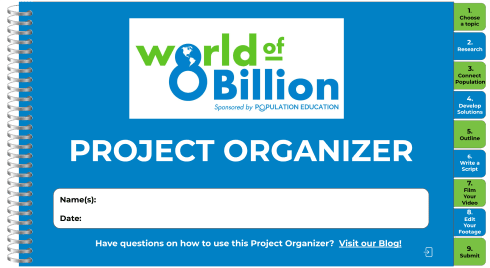
Organize your ideas with the Video Project Organizer, a step-by-step guide to the contest!